
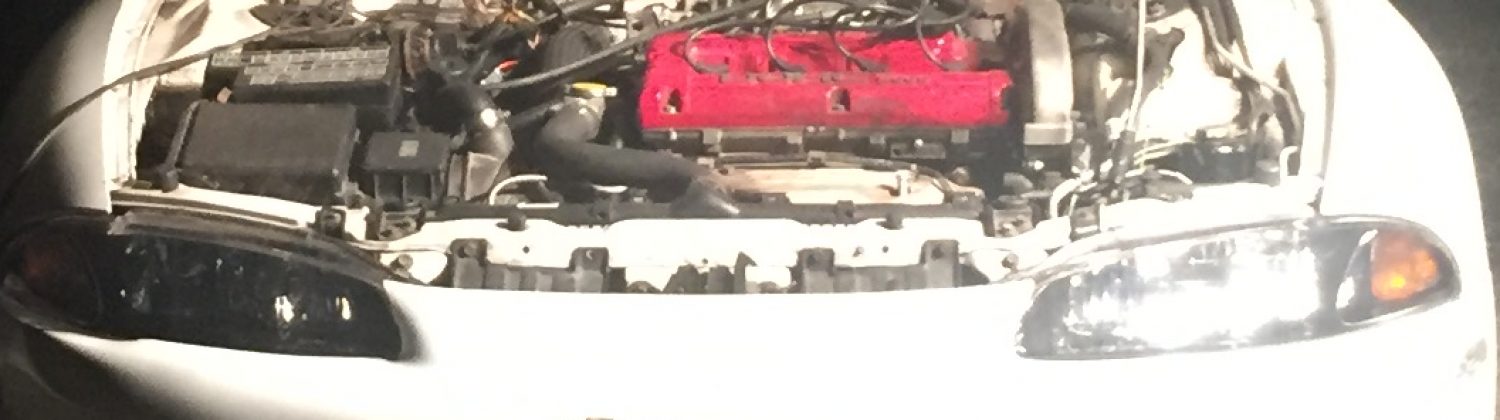
Yuki-onna (or, how I was seduced by a ’98 Eclipse)
Dangerous Nostalgia
My first exposure to the Mitsubishi Eclipse was when I played Need for Speed Underground on PlayStation 2. Alongside the Dodge Neon, it was my favorite car to customize and tune. I told myself that someday I would buy one.
When I started looking for cars, I came across one that looked like the Eclipse from the original Fast and Furious film.
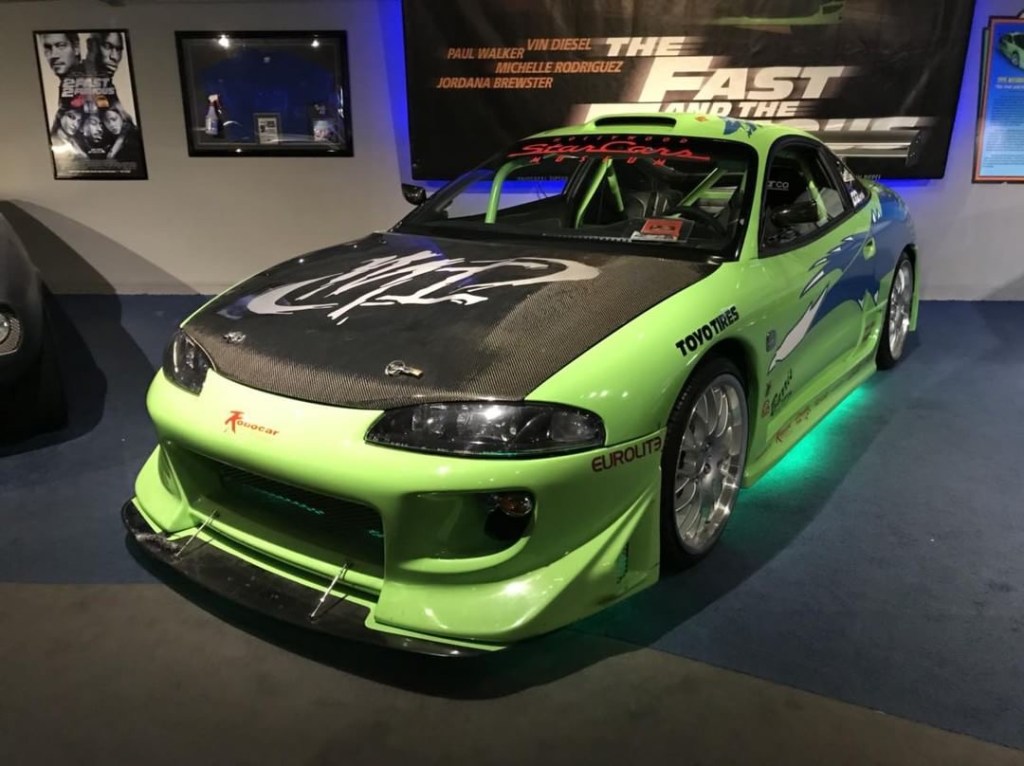
At the time that I was at the age to purchase a car, body kits and underglow like you see above were fading out of style. So, I was just catching the tail end of this fad, but I didn’t know it. I wanted that sick style with the crazy colors, bright neon, and flamboyant aero kits. Unfortunately (or fortunately I guess), the New York winters prevented me from getting that car because it was so low; there was no way I was going to be able to drive it in the snow. Here in Western New York, the snow gets pretty deep, so I would be like my own snow plow – for about five feet until the car couldn’t move any further (you’d think I’d remember this, but I put body kits on my Integra; guess how many times I got stuck in the snow…).
I find my path to purchasing cars interesting because I’ve always known what I wanted, but it just wasn’t always the right time. Nearby my house was a guy selling a metallic blue Dodge Stealth. Now, if you know anything about the Stealth, you’ll know that it came out of an era in Mitsubishi and Chrysler’s history where they joined together to create cars (known as “Diamond Star Motors” or “DSM”). Thus, the Stealth is a rebranded version of a car I would later (and still) own, the Mitsubishi 3000GT.
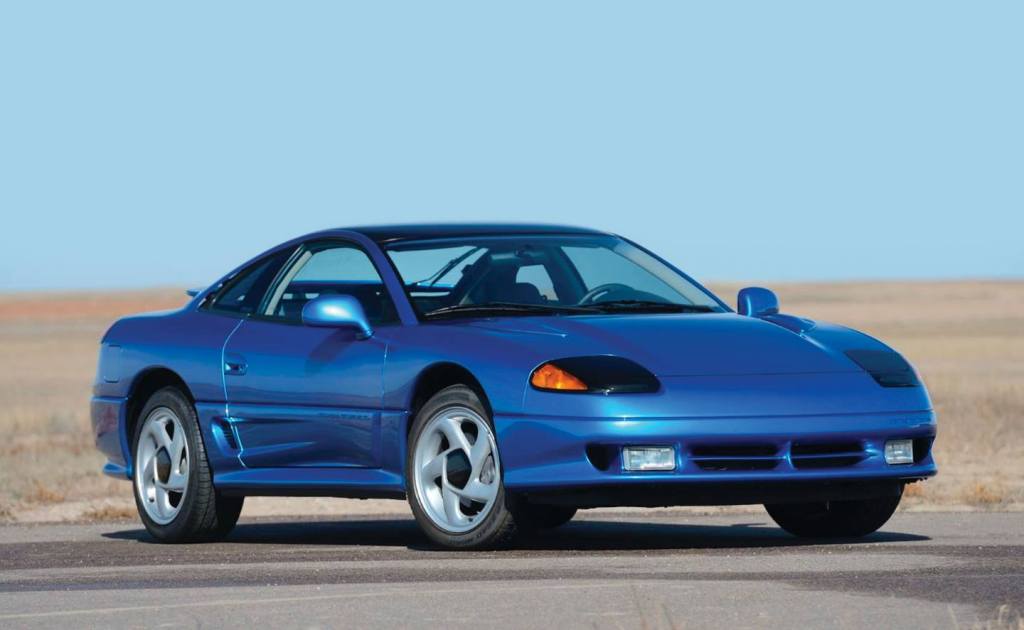
But right next to that car was a 1998 Acura Integra coupe for sale. I really wanted that Stealth, but at the time, I had heard that Mitsubishi’s cars from that era were unreliable. This would turn out to be untrue, but I bought the argument and subsequently purchased the Integra.
I’ll say that Integra was one of the best cars I’ve ever owned, and I have other stories about that car for another post. Anyways, suffice it to say that I passed up on the Stealth (or 3000GT) and the Eclipse.
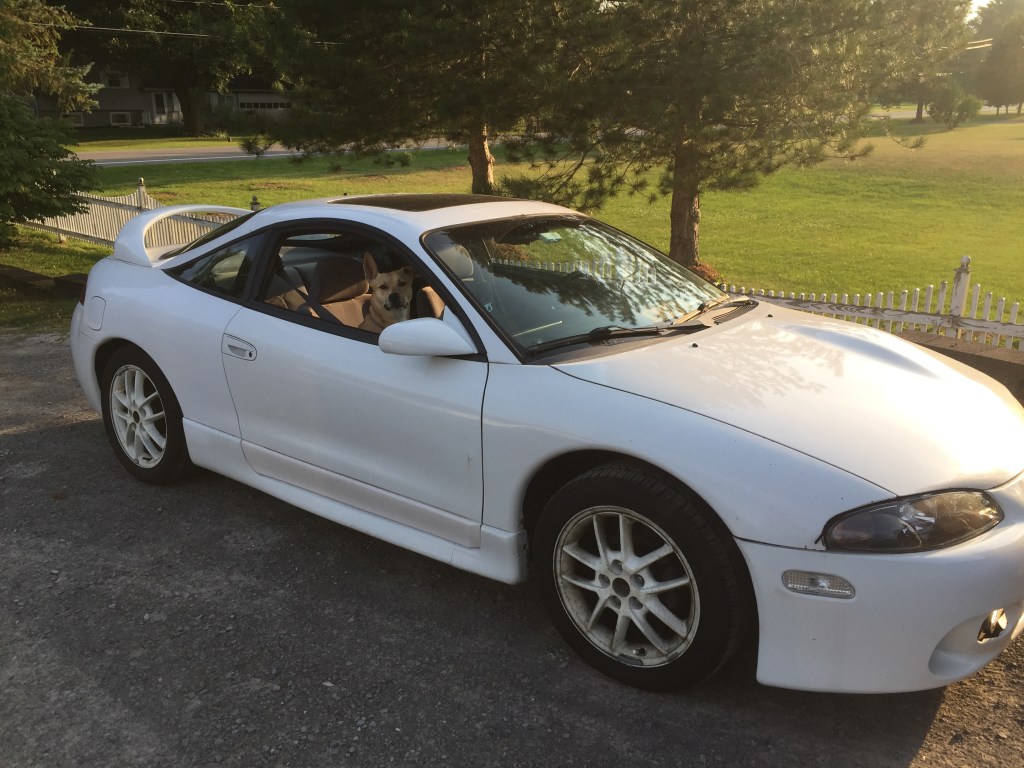
Fastforward to late 2018 and I was searching for another car to replace my Lancer. And then I saw it. For sale on Craigslist was a 1998 Mitsubishi Eclipse GST with an all-wheel-drive swap. That modification essentially made it a GSX; the GST and the GSX were identical with their famously indestructible turbocharged 4G63 engine, except that the GSX usually came with leather and was all-wheel-drive instead of front-wheel-drive.
I told myself I shouldn’t. How was I going to drive that in the winter? “Well, it is all-wheel-drive,” I reasoned. “And, it doesn’t have body kits, so it is high enough off of the ground to clear the snow.” Despite looking at other cars, I kept telling myself whatever I needed to believe until I finally went out to look at it.
The guy I was buying from had picked the car up from Connecticut and had only driven it 100 miles since then. He had taken it racing a few times (no, not on a track) because it was actually modified more than I had anticipated. It had a Walbro fuel pump, 1050cc fuel injectors, a front mount intercooler, and a 16g turbocharger. All that is to say it had somewhere around 300hp when the turbo was fully spooled.

I hopped in at his behest, although he said he would drive because the performance clutch was hard to get used to (he wasn’t lying). As he was backing out of the driveway, the car started to stall a bit. He gave it gas to keep it alive, looked at me, shrugged his shoulders and said, “Tuner cars.” I was too in love with the Eclipse to be worried about any of that.
As we drove, he told me that the car was running very rich because it needed a tune on the computer. As a simple explanation, if you start messing with the fuel pressure and injection, you eventually do so beyond the computer’s ability to adjust within the range it has been programmed. Thus, you can end up burning too little (running lean) or too much (running rich).
He took me out onto a main road, brake-boosted the turbo (where you hold the brake and gas at the same time to build turbo pressure), and the resulting acceleration threw me back in my seat. I knew then that I had to have it.
It wasn’t long after that it was sitting in my driveway, the transaction complete. I finally had an Eclipse, after all this time!
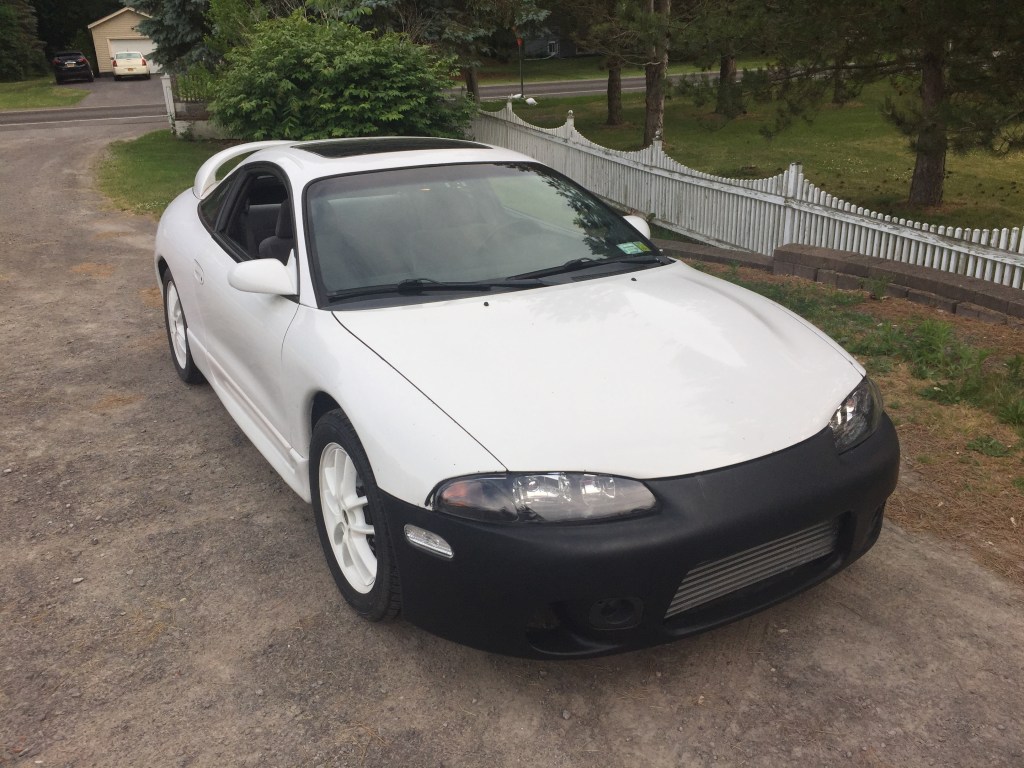
It wouldn’t be long though before I began to discover the trouble I was in…
A Short Honeymoon Phase
One of the first signs of trouble I noticed occurred while I was driving it to work. I would accelerate quickly, getting the turbo running high. Upon arrival at a stoplight, the car would almost die. I would have to give it gas just like the guy did in order to keep it running. It was odd, but nothing too troublesome.
Then came the gas mileage, the single realization which resulted in a cascade of time and money. I noticed I had to fill up for gas quite often, but it wasn’t until I took my friend to Pennsylvania to get a car that I understood just how bad it was. On the highway, the best I was getting was 17mpg, but it was usually an average of 15. I had to stop so many times to get gas, and the bill was somewhere around $180 by the time we got back home.
I knew I couldn’t let that continue, so I bought tuning software to try and modify the computer. Only problem was, I didn’t realize at the time there was another part I needed (a fuel pressure regulator) to make this work. I researched and tuned and retuned until I was blue in the face, but to no avail. I couldn’t get it to work. I decided then that I would revert the car back to its stock form, so that it was at least reliable to drive. Winter was coming and I needed to get this done quickly.
I started sourcing parts, from stock fuel injectors to the original turbocharger. Stephen Miller over at Miller Import Parts was a godsend. He provided me with just about everything I needed.
Once I finally had everything, I took about two full days to tear everything aftermarket out of the Eclipse, returning it to its OEM form. I reflashed the computer with the stock programming and was set to go.
I was only able to enjoy it a brief time. One morning, it just wouldn’t start. After doing some testing and research, I found that the Crankshaft Position Sensor was not working. This device basically tells the computer where the crankshaft and pistons are in their cycle so that it can provide the proper timing for fuel and ignition. If it stops working, the whole car shuts down as a safety measure.
It was not going to be an easy fix. The sensor was located at the very bottom of the engine behind the timing cover. Furthermore, in order to do it properly, you would need to remove the timing belt (an involved process).
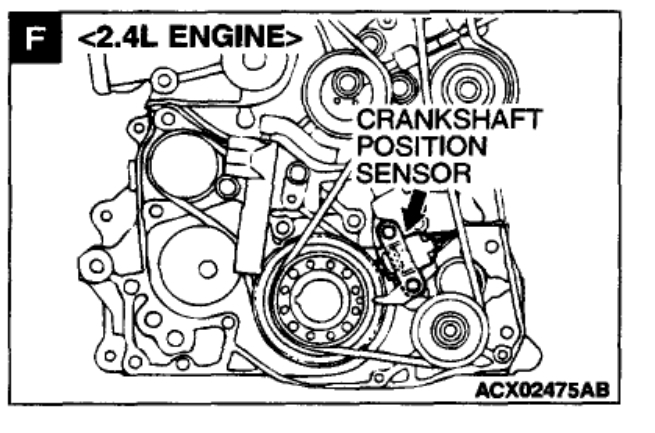
I kinda cheated by loosening the timing belt and then tightening it back up again. Remember that I said that… With everything reassembled, I was able to drive the car again and enjoy it — for about two days.
Driving back from teaching welding one night, I heard a clicking sound coming from the engine bay. Maybe my oil was low? Stopping the car, I got outside and and stood next to the hood to try to get a good listen. Unable to discern anything, I opened the hood; the noise was louder, but even less traceable. The hard thing about trying to listen for noises from an engine is that they seem to come from everywhere. Pinpointing a problem by locating the source of the sound can be difficult.
I figured the best thing I could do was to drive it home as quickly as possible and sort it all out later. Each time I accelerated, the clicking grew louder. I thought back to my little cheat with the timing belt….
The reason this concerned me so much was that I knew the Eclipse had an interference engine. In an engine, there are valves which move up and down to let in air and let out exhaust. In non-interference engines, the valve will never be in the path of the piston, so if something goes wrong with the timing, there is no issue. However, in an interference engine, the valve moves directly in the path of the piston. This only happens when the piston is not there. All of this is controlled by the timing belt, which keeps the valves opening and closing at the appropriate points. If the belt slips and the timing is off, the pistons can strike the valves and bend them, dropping compression and rendering your upper engine useless. The repair parts are expensive and the time involved is extensive.
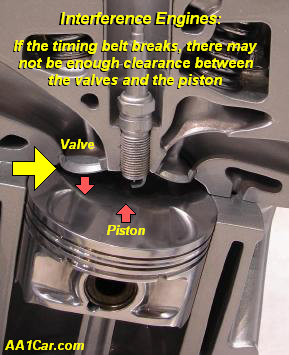
So when the car finally quit running and coasted to a stop, you can imagine my fear. As the tow truck driver chained up my car, I couldn’t help but wonder if my worst nightmare had come true. I’d have to take the timing cover off to see what had happened.
The next day, I lifted the car up again and removed the timing cover. What I found was both frightening and a relief. Down near the bottom of the the cover, my trusty friend the Crankshaft Position Sensor, had exploded. Not in a ball-of-flame kind of way, but rather as if it had flown apart. I couldn’t figure out how this happened. Then I looked at the crank trigger plate.

One of the fins of the plate was slightly bent. That would explain the clicking sound. It was making contact with the “jaws” of the CPS. But how would that have even happened? Scrounging around the bottom of the timing cover, I discovered a small piece of hard plastic. Immediately I knew what had gone down.
When I first bought the car, I noticed that the upper timing cover was missing. If you look at a diagram of the timing cover, you’ll notice it is composed of three parts: upper, middle, and lower.

This wasn’t the only problem. The middle cover was actually melted near the top. How that happened, I have no idea. Many plastics when heated like this become brittle when they cool. With nothing guarding debris from falling into the timing belt, a piece of this brittle plastic had broken off, fallen all the way to the bottom, and become lodged between the crank plate and the CPS long enough to bend the former. It then broke free, laughing as it watched the chaos it had ignited erupt in a shower of plastic and metal bits (yes, I personified it; yes, it was personal).
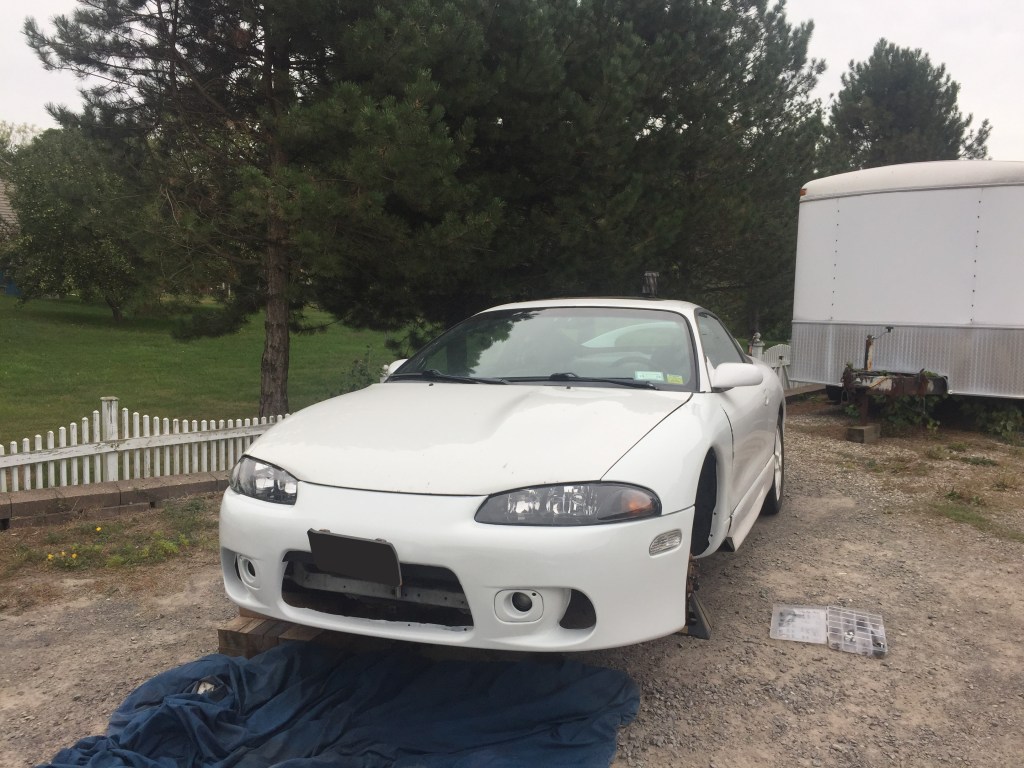
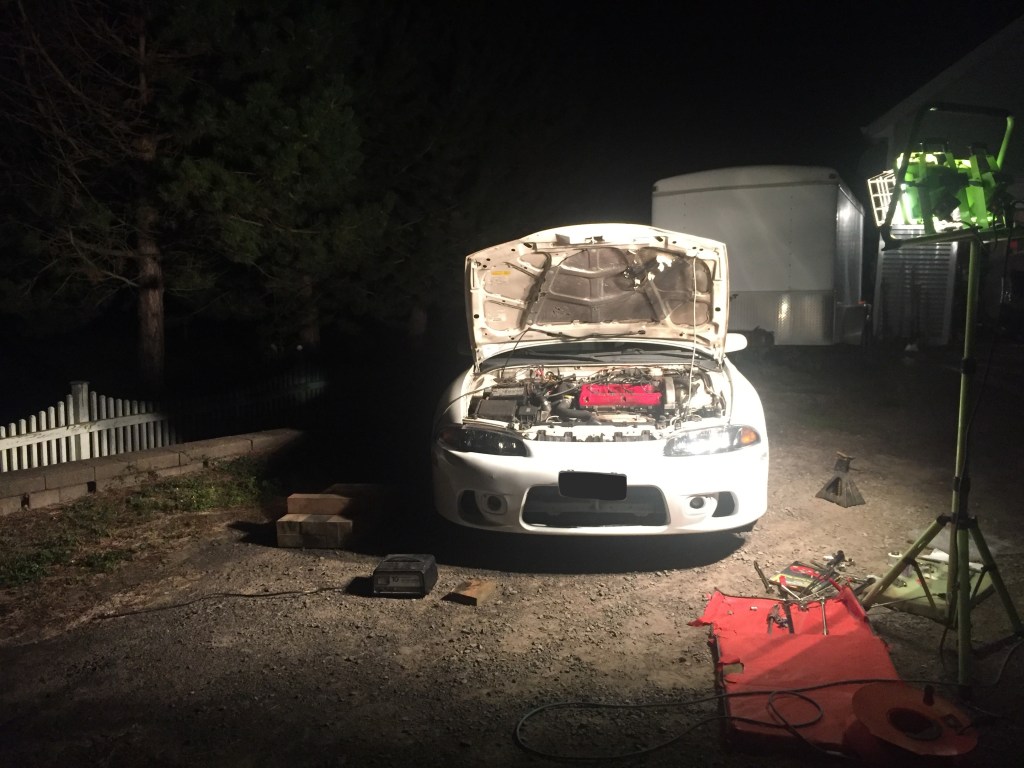
I was so relieved that it had not caused any more damage. I was lucky that the timing belt had not slipped, which might have obliterated the valves. I replaced the sensor and everything was back to normal again… for a little while.
Complacency and Hypothermia
I often make trips to Detroit to visit my fiancée. It’s around 5 hours away, roughly 300 miles from where I live. For a while now, I had been taking the Eclipse back and forth there, racking up the miles, and everything was just grand. I was happy, the car was running well. Life was good. I did endure one winter of having little heat as I drove there because the heater core died, but that wasn’t too bad.
On one particular trip there, I noticed that when I would put my foot on the accelerator, the car would increasingly shake as the turbo spooled up. I figured this was a residual problem of a bad shock.
See, months before, I had been having problems with the car shaking at around 65mph. This turned out to be a bad shock, which is the interior part of the spring that rebounds when you go over bumps (you know, so your teeth don’t fall out when you hit one of the many potholes around here). If the shock goes bad, it not only fails to absorb impacts, but it can also cause the tire to go off balance and wear unevenly. This is why the car shook under acceleration.
My initial theory started to fall apart when I exited the expressway toward Ambassador Bridge. I had been doing 70mph and came off the exit a bit fast, so I depressed the brakes harder than normal. When I finally came to a stop, smoke passed by me. Yikes, I gotta lay off the brakes! I figured I had overheated them. Except, at each stoplight, the smoke returned. Now I wasn’t so sure what was going on. I would take off from a light and leave behind me a smokescreen that would shame even Harry Houdini. It was obvious I was burning oil, but I had no idea why.
I remember going through the border and the border guard, upon handing back my Nexus card, said, “You’re all set,” and looking at the smoke, followed with, “I think…” As I was driving away, I heard one of his colleagues ask earnestly, “Is that car on fire?” No. The only thing burning at that point was my ego.
When I returned home from Detroit, I set upon taking the car apart. Lo and behold, I found that the stock turbo had blown. The turbine had broken free inside and was slowly shearing itself and the housing away. This explained the vibrations. Should I have known better than to buy a used T-25 turbo off of Ebay? Maybe. But it was such a good deal at the time — only $120 — that I forgot to check how many miles were on it. Usually they die at around 100,000 miles. Below, you can see a video of me taking the turbo inter-cooler piping off. When I do, thick oil spills right out. Keep in mind that there should be little to no oil in there. That’s why it was blowing smoke; the oil was getting into the combustion chamber.
Since I was just about to start my MBA, I literally had one weekend to take all of these parts out and replace them with the aftermarket parts again. I needed to use that other turbo that first came with the car. This time, I kept the stock fuel injectors and ran a stock tune so that my fuel mileage would not be egregious.
Okay, but what does this have to do with hypothermia?
Ah, I’m glad you asked. See, there’s this old —
And what’s a “Yuki-onna”?
I was getting there, hold on. Imagine you are walking along a lonely mountain pass, covered in snow. It’s growing darker and colder with every minute, and you’re wondering if you’ll ever reach civilization.
Suddenly, you see a beautiful woman, dreadfully pale yet alluringly elegant. She beckons you to come sit for a moment, to rest from your travels. Despite knowing that you are still in the cold with no shelter, you accept her offer. Seated on a frigid rock, you listen to the woman console you. She tells you that everything will be alright, and there is no need to worry. You feel yourself growing a bit warmer, and the freezing air doesn’t seem so bad.
She continues to speak to you softly, encouraging you to move from the rock to the snow-covered ground. You obey, feeling warmer and safer. You start to wonder why you ever feared the cold. And as you rest there, the woman sweetly tells you to close your eyes and go to sleep…

This is just one version of the Japanese tale, but there are many variants depending upon the region in Japan. In this version, the Yuki-onna is a vengeful Yōkai (ghost) who tempts you toward your death as you freeze in the cold. From the way I understand it, she is kind of an allegory for the experience of hypothermia.
Perhaps now you might see why I decided to name my car “Yuki-onna.” The allure of the Eclipse was just so strong, lulling me into complacency just in time to “close my eyes” and have a crankshaft position sensor explode, or a turbocharger blow up. And yet I love it. I can’t get enough of Diamond Star Motors. And no, my experience has not changed my view of these classics from the Nineties. I mean, let’s be honest: Yuki-onna has over 185,000 miles. Things are bound to break eventually. I just hope she’ll give me a break for a while — and no, not a rest in the snow.
Categories

 Bernard's Garage
